
By Anton Baranoff
TL;DR: Why CDU Monitoring Is No Longer Enough
- AI workloads need larger liquid cooling systems. Traditional monitoring shows equipment health, but it may not reveal available cooling capacity or backup limits.
- Next-generation DCIM solutions, like Modius® OpenData®, connect power, cooling, and IT data. This helps data center operators assess capacity and plan future AI deployments.
A single coolant distribution unit (CDU) can now support megawatts of AI computing. At 120 kW per rack, a row of 20 AI racks needs about 2.4 MW of IT power.
As high-performance computing grows, so does the need to manage heat from AI systems.
Traditional CDU monitoring tracks equipment status, temperature, pressures, and flow rates. These measurements matter, but they don't answer one key question: How much cooling capacity is actually available?
To find out, operators need to look beyond equipment monitoring. They also need to manage cooling capacity.
What Is a CDU in a Data Center?
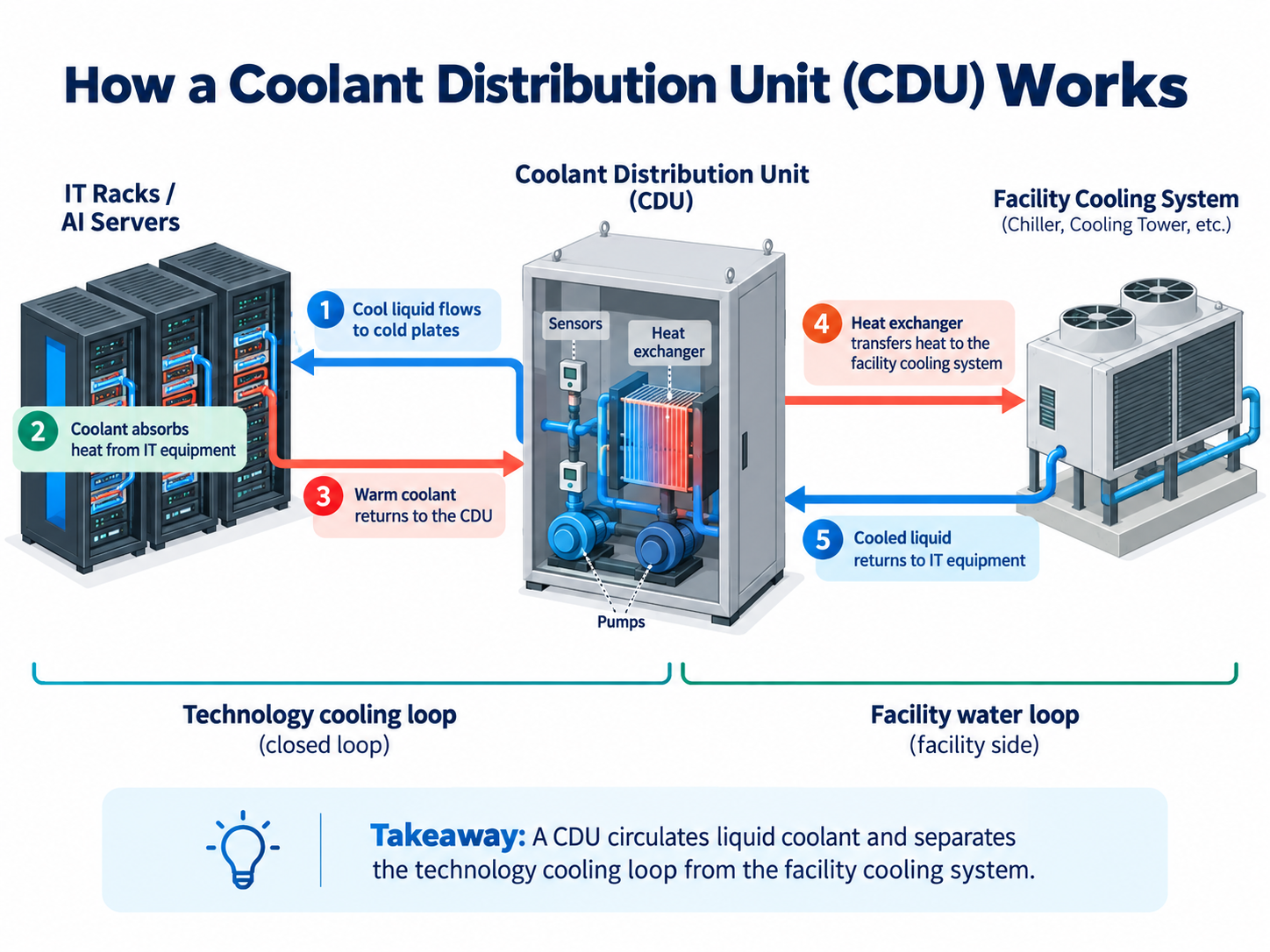
A coolant distribution unit (CDU), also known as a cooling distribution unit, moves liquid coolant. This helps remove heat from IT equipment.
CDUs use pumps, sensors, and heat exchangers to control coolant flow and temperature. They also keep the technology cooling loop separate from the facility water supply.
Here's how the cooling process works:
- Liquid coolant flows through cold plates on processors.
- The coolant absorbs heat from IT equipment.
- Warm coolant returns to the CDU.
- Heat exchange transfers heat to the facility cooling system.
- Cooled liquid returns to the IT equipment.
This process helps keep equipment at safe temperatures in high-density data center environments.
As AI demand grows, coolant distribution units (CDUs) help operators manage heat loads and plan for future growth.
Why CDU Monitoring Is Only Step One
Modern CDUs track several operating conditions:
- Coolant temperatures and flow rates
- Pump operation and equipment alarms
- Heat exchanger performance
- Equipment status and cooling performance
These measurements show how equipment operates. But they may not reveal how much cooling capacity remains.
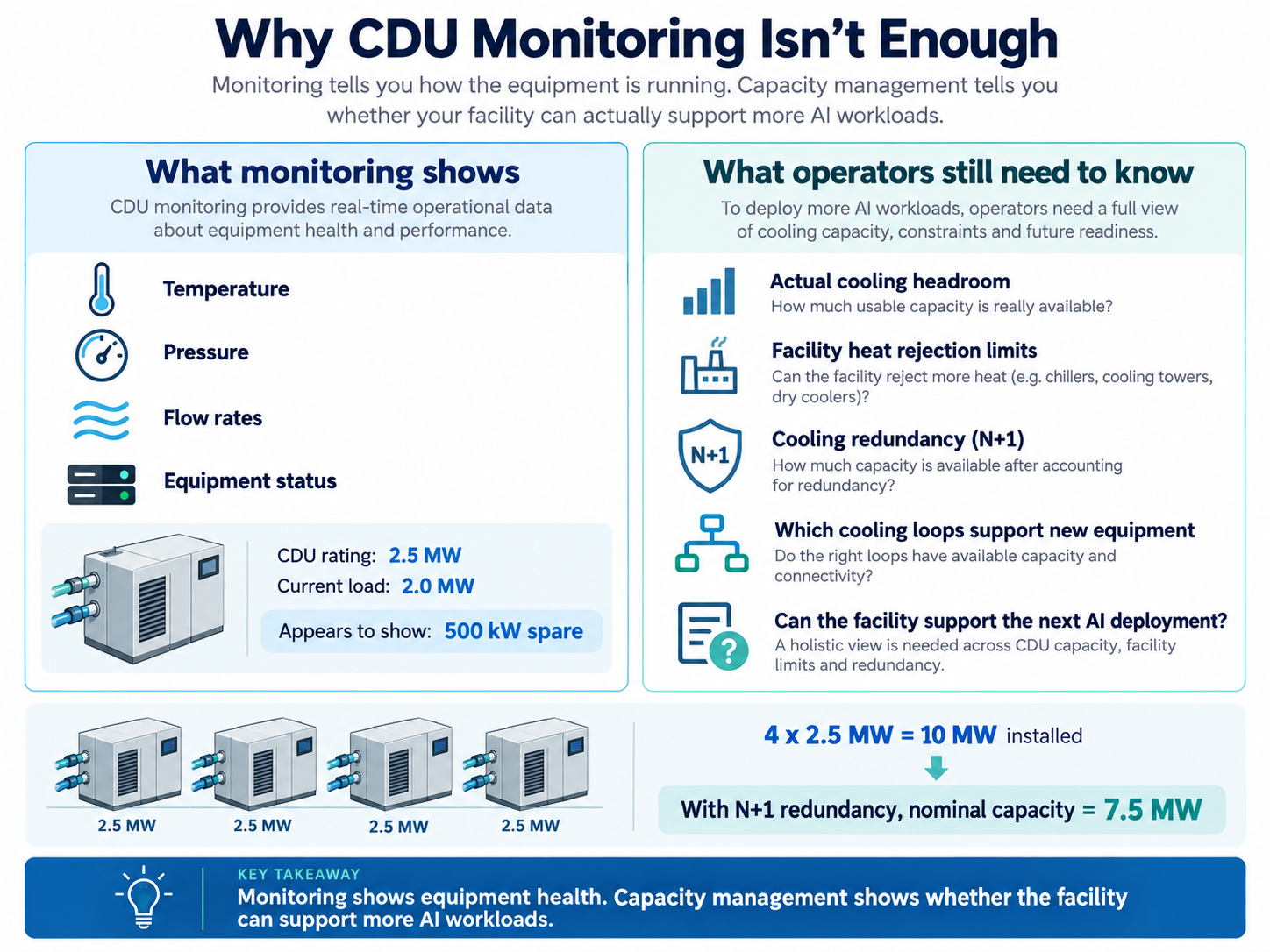
Consider a CDU rated at 2.5 MW.
If it handles a 2 MW cooling load, it appears to have 500 kW of spare capacity.
Can data center managers safely add another 500 kW of IT load?
Not necessarily.
Actual capacity depends on coolant flow, temperature, equipment limits, and facility conditions.
Even if a CDU has spare capacity, the main cooling system may not have capacity to remove the added heat.
A CDU can operate normally while the facility approaches its cooling limits.
This is why equipment monitoring alone cannot support reliable capacity planning.
From CDU Monitoring to Cooling Capacity Management
Traditional data center capacity planning focuses on rack space and power. AI workloads require the same attention to cooling.
Operators need to consider three factors.
1. Available cooling headroom
Installed cooling capacity and usable capacity are not always the same.
For example, a CDU may have a 2.5 MW rating. But actual capacity can change with facility water temperatures, flow rates, and equipment performance.
Operators need to measure current loads and available capacity before adding new equipment.
2. Cooling redundancy
Suppose a facility has four CDUs rated at 2.5 MW each.
Together, they provide 10 MW of installed cooling capacity.
With N+1 redundancy, one CDU serves as backup. This leaves 7.5 MW of nominal capacity.
Actual usable capacity may be lower. Shared equipment and operating limits can reduce it.
Operators must account for backup capacity before assigning cooling resources to new workloads.
3. Future IT demand
Adding an AI rack increases power use and heat.
Operators need to know which cooling loops serve the new equipment and how much cooling headroom remains.
They must also confirm that enough backup capacity is available.
This helps teams plan new AI deployments without exceeding cooling limits.
What Next-Generation DCIM Should Look Like
Modern data centers need more than separate monitoring dashboards.
Next-generation DCIM connects infrastructure data to help operators monitor performance and plan capacity.
Four capabilities matter most:
- Treat CDUs as capacity assets. Track equipment ratings, current loads, and remaining capacity.
- Connect power and cooling. Track how IT demand affects cooling needs and energy efficiency.
- Integrate existing systems. An existing data center often uses equipment from several manufacturers. Operators need data from CDUs, chillers, pumps, BMS platforms, and electrical systems.
- Use historical data. Trends help teams track demand, find recurring problems, and identify capacity limits.
Modius OpenData brings power, cooling, environmental, and IT data into one view.
Its vendor-agnostic design supports monitoring, analytics, and capacity planning across existing systems.
This helps operators track performance and find capacity risks before adding new workloads.
Data Center Thermal Management for AI
As AI rack density rises, traditional air cooling may struggle to remove enough heat.
Direct-to-chip liquid cooling helps cool high-power processors. But operators must also manage coolant temperatures, pressure, and flow.
Shared cooling loops create more risks. A problem in one loop may affect several racks.
Effective data center thermal management requires a clear view of equipment performance and available cooling capacity.
Operators must know how much cooling they use today and whether their systems can handle future demand.
The Bottom Line: Cooling Capacity Matters More Than Ever
CDU monitoring remains essential. But equipment status alone cannot show whether a facility can support more AI workloads.
Operators also need to track cooling limits, backup capacity, and power demand.
Next-generation DCIM brings this information together.
Modius OpenData connects critical infrastructure systems. It helps operators monitor performance, manage capacity, and plan for growth.
Explore how Modius data center infrastructure management software supports infrastructure monitoring and capacity planning.
For more on power infrastructure, read the blog: AI Data Center Monitoring Needs Source-to-Rack Visibility.
Frequently Asked Questions
What is a CDU in a data center?
A coolant distribution unit circulates liquid coolant to remove heat from IT equipment. It controls coolant temperature, pressure, and flow.
The Modius OpenData Monitoring Module connects cooling equipment measurements with other infrastructure data to help teams monitor cooling operations.
How do you calculate data center cooling requirements?
Start with IT power use and expected heat output. Then assess coolant flow, temperature changes, equipment capacity, and backup needs.
The Modius OpenData Planning Module helps teams assess cooling capacity and plan changes using current infrastructure data.
Why isn't CDU monitoring enough for AI workloads?
CDU monitoring shows equipment conditions. But it may not show how much cooling capacity remains.
The Modius OpenData Cooling Module helps operators monitor cooling performance and assess operating conditions.
How does next-generation DCIM support liquid-cooled AI data centers?
Next-generation DCIM connects power, cooling, and IT infrastructure data. It helps operators identify capacity limits and plan new deployments.
Modius OpenData DCIM brings these systems together. This helps teams monitor performance, manage capacity, and connect critical infrastructure.