

TL;DR (Executive Summary)
- Effective and accurate data center capacity planning can only be accomplished with a clear understanding of the nameplate capacities and current loads for each infrastructure component.
- Track capacity and provide trend reporting on rack space and cooling infrastructure components, measured against current operating telemetry data to enable future demand and expansion.
- Reveal where seemingly available power, space, cooling, or connectivity is stranded by a constraint elsewhere in the infrastructure.
- Scenario planning lets operators test proposed changes, reserve capacity, and validate redundancy before equipment arrives.
- For AI and high-density deployments, real-time capacity data helps teams assess power headroom, cooling capacity, rack capacity, and upstream constraints together.
How to know where capacity exists before you deploy
Available capacity cannot be determined by looking at an individual infrastructure resource in isolation. Capacity may appear to be available at the immediate resource provider, while constraints elsewhere in the supporting power, space, cooling, weight, or network infrastructure limit what can actually be deployed.
Modius ®️OpenData®️ Planning evaluates these interconnected resources against current infrastructure data to determine where equipment can be deployed. Teams can see available headroom, identify the resources limiting capacity, model planned changes, and confirm that a deployment can be supported before equipment is ordered for the site.
Request a Demo · Start a Free Trial
See capacity across power, space, cooling, and weight
Capacity questions are often answered by one resource at a time. Facilities teams may track UPS load, while IT teams manage rack layouts and asset placement. Effective data center capacity management brings those constraints together to show how much capacity is available for deployment today.
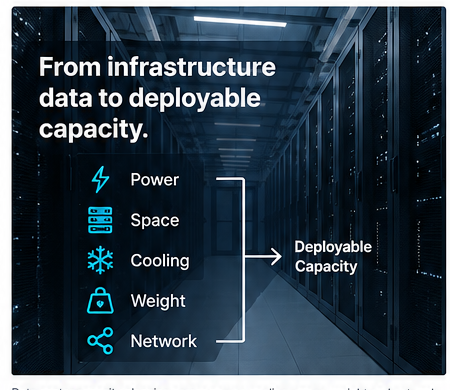
OpenData Planning shows available capacity by site, room, row, and rack across:
- Power — measured load and remaining power headroom at the rack PDU, PDU/RPP, UPS, and upstream feed
- Space — usable rack units, not just empty ones
- Cooling — available cooling capacity based on actual heat load
- Weight — rack and floor loading limits
- Network — available ports and paths
OpenData collects and updates this data on an ongoing basis. The capacity view reflects the facility as it operates now, not how it looked during the last audit.
Know what can actually be deployed
Deployable capacity is the smallest amount of remaining headroom across every upstream resource that a deployment needs.
A rack may show 12 available rack units. But rack capacity depends on more than space. If the branch circuit has no remaining power, that rack cannot support the deployment.
The OpenData Planning Module identifies the limiting resource at the rack, row, and room level. Teams can then plan against capacity values that reflects real conditions.
Find stranded capacity you already paid for
Stranded capacity looks available but cannot be used because another resource is constrained.
Common causes include:
- Imbalance in resource capacity. For example, stranded rack U-space because the available power has already reached its designed capacity.
- Leaving redundancy out of usable-capacity calculations.
- Not removing or cleaning up reservations that are no longer applicable.
OpenData provides additional insight via a combination of power, space, and cooling resource blocks along with a large selection of dashboards and reports to help identify stranded capacity situations.
Model changes before touching infrastructure
OpenData Planning lets teams test equipment adds, moves, and decommissions against current operational data.
A plan can check:
- Rack space and weight
- Rack power and circuit loading
- PDU, UPS, and feed capacity
- Cooling impact
- Network ports and paths
- Redundancy after the change
For example, if a team removes a server in a plan, OpenData updates the expected power load through the upstream power chain.
Compare planning options side by side
Teams can build and compare several plans at the same time.
They can test different rooms for a new deployment, compare a consolidation with an expansion, or keep a failover plan ready for future use.
Each plan can move through draft, review, approval, and execution. This creates a clear record of the decision-making process.
How to understand upstream power limits
Rack-level planning alone does not provide a complete capacity view.
A deployment may fit inside a cabinet but still exceed the branch circuit, PDU, UPS, or upstream feed.
OpenData models the power chain from the rack PDU to the PDU/RPP, UPS, and utility source. If direct telemetry data monitoring is not in place, teams can enter estimated values to fill gaps.
This lets teams begin capacity planning before all devices are configured for monitoring.
How to reserve capacity and avoid double booking
Available, reserved, and consumed capacity are different numbers.
OpenData Planning will record available, reserved, and consumed capacity separately. When a project is approved, the system removes its reserved capacity from available headroom before the hardware arrives.
After deployment, teams can compare the plan with the actual state. This helps maintain alignment between planning models and the current state for the facility.
How to validate redundancy before approval
Usable capacity must account for required resilience.
OpenData checks planned changes against N, N+1, and 2N requirements. Teams can review the post-failure state before they approve a plan.
This helps prevent a new deployment from using headroom that the site needs for redundancy.
Capacity planning for AI and high-density infrastructure
AI and GPU deployments put more pressure on traditional planning models.
Power density can rise faster than floor space is used. Dense hardware can reach rack and floor weight limits sooner than expected. Cooling may become the main constraint, and liquid cooling adds new planning needs.
Upstream electrical headroom can also become the true limit long before the white space is full.
Static spreadsheets struggle to keep pace. Real-time data and scenario planning give operators a more current view.
Example: can we install twelve 10 kW GPU servers?
A request arrives for twelve GPU servers at 10 kW each, or 120 kW total.
The floor plan shows enough space. That does not mean the deployment will work.
Before approval, the team should check:
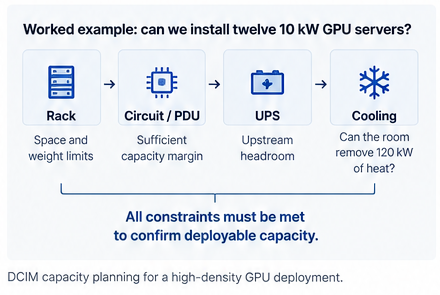
- Rack space: Confirm that the servers fit within the target racks.
- Rack weight: Confirm that rack and floor loading remain within their limits.
- Rack power: Verify that the rack can support the additional load.
- Branch circuit: Confirm sufficient capacity margin.
- PDU/RPP: Confirm available upstream headroom.
- UPS: Verify support for the added load at the required redundancy level.
- Cooling: Verify that the room can remove the additional 120 kW of heat at the deployment location.
- Network: Confirm that sufficient ports and paths are available.
- Redundancy: Verify that the facility can still handle a failure after deployment.
The answer is the smallest amount of remaining capacity across those limits.
Spreadsheets vs. DCIM capacity planning
Spreadsheets can work in simple environments, but they depend on manual updates and periodic audits.
OpenData Planning uses current operating data. It also models infrastructure links, supports several plans, tracks reservations, and compares planned state with actual state.
The difference is simple: spreadsheets describe what should be available. DCIM capacity planning can show what is available now, and with a high degree of accuracy if the infrastructure equipment is configured with OpenData live telemetry monitoring data.
Related resources
Learn more about Modius OpenData, Power Management, and Asset Management. For additional background, see What Is DCIM? and How Colocation Providers Find and Reclaim Stranded Power Capacity.
Frequently Asked Questions
What is DCIM capacity planning software?
DCIM capacity planning software shows how much power, space, cooling, weight, and network capacity are available in a data center. It also tests planned changes against those limits so teams can see what they can actually deploy.
Should capacity planning use real-time data?
Yes. Data center capacity planning is more accurate when it uses current measured data instead of relying only on nameplate ratings or periodic audits. The OpenData Planning Module checks planned changes against current measured data. Teams can plan against actual load instead of relying only on nameplate ratings or periodic audits.
How does capacity planning reduce stranded capacity?
The system identifies the resource that limits capacity at each rack, row, or room. Once teams see the bottleneck, they can rebalance load, clear old reservations, or remove unused equipment to free capacity.
Capacity planning helps identify what is limiting usable capacity at each rack, row, or room. Once teams see the constraint, they can rebalance load, clear old reservations, or remove unused equipment. The OpenData Planning Module brings these constraints together, so teams can see where capacity is available and what is limiting it.
Can multiple plans run at the same time?
Yes. Multiple plans or deployment scenarios can be evaluated separately and moved through their own approval processes. The OpenData Planning Module allows teams to build and compare multiple plans without changing the live environment.
Do we need full device monitoring before we can plan capacity?
No. Capacity planning can begin with the data already available. Where direct measurements are unavailable, estimated or combined values can be used, with accuracy improving as monitoring coverage expands. The OpenData Planning Module supports this approach so teams do not have to wait for complete instrumentation to begin planning.