
Executive Summary
A detailed analysis of the 2025 South Korean data center fire reveals how integrated DCIM solutions like Modius OpenData enhance data center resilience, ensure compliance, and prevent catastrophic failures through unified monitoring, asset management, and best practices.
Key Takeaways
- The 2025 South Korean data center fire, triggered by a battery failure, resulted in severe data loss and operational disruption
- Siloed management of facility and IT systems prevented unified risk awareness, worsening the disaster
- Physical and digital resilience are inseparable in today's data centers
- Data Center Infrastructure Management (DCIM) is mission-critical for prevention, continuity, and protection
- Modern DCIM solutions deliver unified, real-time visibility across all systems, enabling operators to stop failures before they cause outages
Why the South Korean Data Center Fire Matters for Your Operations
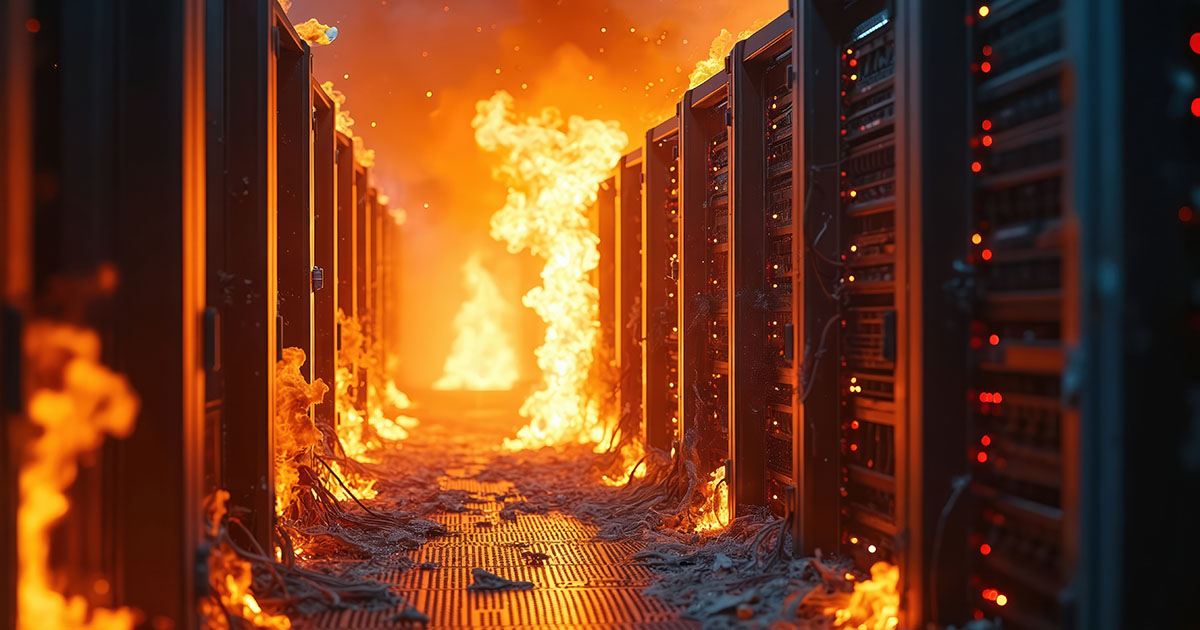
In September 2025, a catastrophic lithium-ion battery fire at South Korea's National Information Resources Service (NIRS) data center in Daejeon disabled hundreds of government systems and resulted in the permanent loss of hundreds of terabytes of critical data.
The cause was a lithium-ion battery thermal event during a maintenance procedure—a stark reminder that physical and digital resilience are fundamentally linked. When fire, power, or cooling systems fail, IT operations are inevitably at risk.
Without a comprehensive Data Center Infrastructure Management (DCIM) strategy that integrates environmental monitoring, asset management, and recovery planning, even well-intentioned maintenance can spiral into disaster. This incident underscores why DCIM software is essential for prevention, continuity, and protection.
What Caused the South Korean Data Center Fire?
The NIRS fire began as contractors relocated aging lithium-ion batteries from the IT floor to the basement. One of these batteries went into thermal runaway, igniting a fire that burned for almost a full day. Over 200 firefighters and 60 fire engines were needed to contain the blaze.
Key Contributing Factors
Aging batteries: Some were 11 years old, well past their safe lifecycle, increasing the risk of failure.
Volatile chemistry: The batteries used nickel-manganese-cobalt (NMC) chemistry, known for high energy density but also high volatility and fire risk.
Basement placement: Moving batteries below grade created a confined environment where heat and gases could not escape.
Inadequate fire safety systems: Suppression and ventilation systems were not designed for lithium-ion fires.
Poor data recovery planning: Hundreds of terabytes of government data were lost due to the lack of off-site backups and replication protocols.
Each issue is a known risk, but together, they reveal a larger systemic problem: siloed operations. Electrical, mechanical, and IT systems were managed separately, without a unified risk view—highlighting the necessity of integrated DCIM.
How DCIM Prevents Single Points of Failure
A fully implemented DCIM platform brings unified visibility into power, cooling, and IT systems. This integration—what Modius calls "bridging the white space and gray space"—enables operators to detect and respond to anomalies before they escalate.
How DCIM Addresses Core Data Center Risks
Real-time monitoring: Tracks temperature, humidity, current draw, and battery health for early detection of thermal irregularities.
IoT asset management: Smart sensors and connected devices feed actionable data to a centralized dashboard, providing a holistic operational view.
Capacity planning: Operators can model hardware changes (like battery moves) to evaluate thermal load and risk before implementation.
DCIM security: Role-based access and event logging ensure all changes are tracked and authorized, reducing maintenance risks.
Disaster recovery visibility: Integration with IT systems enables operators to validate, monitor, and test backup and replication workflows.
When DCIM bridges operational and information technology, risk visibility becomes continuous rather than reactive—often the difference between a controlled shutdown and a catastrophic outage.
Lithium-Ion Battery Safety in Data Centers
The NIRS fire reignited global discussions about lithium-ion battery safety in data centers. While these batteries are common in Uninterruptible Power Supply (UPS) systems for their high energy density, the event proved that battery chemistry and lifecycle management are critical.
Comparison of Common Lithium-Ion Battery Chemistries
| Battery Type | Energy Density | Fire Risk | Cycle Life | Typical Use |
|---|---|---|---|---|
| NMC (Nickel-Manganese-Cobalt) | High | High | Moderate | Older UPS systems |
| LFP (Lithium Iron Phosphate) | Moderate | Low | Long | Modern UPS, safer alternative |
| LTO (Lithium Titanate) | Low | Very Low | Very Long | High-safety, long-life systems |
Modern fire safety codes (NFPA 855, IFC 2021) now restrict below-grade battery installations unless engineered mitigations are in place. But regulatory compliance is not enough—operators must have real-time visibility into system performance. Integrated DCIM monitoring delivers the necessary data to verify compliance and detect abnormal conditions before they escalate.
Building True Data Center Resiliency
Resilience in the data center is more than redundant power and cooling. It requires all critical systems—electrical, mechanical, and digital—to function as one. DCIM software enables this by creating a single source of truth.
Best Practices for Resilient Data Center Management
- Implement continuous DCIM monitoring for all facility assets, not just IT equipment
- Validate redundancy in power and cooling paths with automated failover simulations
- Ensure multi-site data replication; regularly test recovery procedures to meet RTO and RPO targets
- Integrate fire safety protocols with DCIM, linking sensors, suppression, and alarms into a unified monitoring layer
- Audit lifecycle management for batteries, servers, and other high-risk components to prevent aging-related failures
- Correlate system data so electrical faults or temperature spikes trigger coordinated action across the infrastructure
When DCIM connects facility operations and IT systems, it transforms the data center from a collection of siloed technologies into a coordinated ecosystem built for uptime and reliability.
The Modius OpenData Advantage
Modius OpenData is a next-generation DCIM platform that closes the gap between facility infrastructure and IT operations. By uniting the white space (IT systems) with the gray space (mechanical and electrical equipment), OpenData provides the situational awareness needed to prevent outages before they occur.
Key Platform Benefits
- Unified monitoring across power, cooling, and network systems
- Scalable data collection from thousands of sensors and devices
- Real-time analytics for capacity planning, energy efficiency, and event correlation
- Comprehensive dashboards for on-premises and hybrid data centers
Whether you manage a hyperscale facility or a distributed network of edge sites, OpenData ensures every operator has the insight to act with confidence and maintain uptime.
Turning Insight Into Action
The South Korean data center fire is a global warning: even advanced facilities are vulnerable when visibility and coordination break down. Resiliency today demands a holistic approach that unites power, cooling, security, and IT systems through integrated DCIM.
Ready to see how Modius OpenData connects your white space and gray space for complete operational awareness?
Schedule a Demo and master your infrastructure with Modius OpenData.
Frequently Asked Questions: Preventing Data Center Fires with DCIM
How does DCIM detect battery thermal events before they cause fires?
DCIM solutions like OpenData use real-time monitoring to collect data from thousands of environmental sensors and power devices, including UPS systems and battery cells. If a battery begins thermal runaway, pre-set thresholds trigger immediate alerts, allowing personnel to isolate the unit or start emergency procedures before ignition. Event correlation pinpoints the exact location and nature of the anomaly, speeding response.
How does DCIM prevent infrastructure from operating past its safe lifecycle?
OpenData's asset management tracks every infrastructure component from deployment to retirement. The system flags batteries or other assets nearing end-of-life, prompting proactive replacement or inspection—before failure occurs.
How does unified DCIM prevent data silos that worsen incidents?
OpenData bridges the gap between facility (power, cooling, fire suppression) and IT (servers, network, storage) operations, consolidating all data into a single, integrated platform. This "single pane of glass" eliminates silos and ensures both IT and facilities teams have real-time, coordinated intelligence.
How does DCIM minimize maintenance-related failure risks?
OpenData integrates change and workflow management, allowing operators to model and approve complex moves (like battery relocation) before execution. Analytics and dependency mapping highlight related risks, providing situational awareness that turns raw data into actionable insights.
How does DCIM improve overall data center resiliency beyond fire prevention?
OpenData supports real-time and historical analytics on power capacity, utilization, and redundancy design. Predictive analytics and machine learning anticipate potential issues, allowing teams to shift workloads, back up data, or failover to redundant sites—transforming operations from reactive to proactive.
About Modius
Modius delivers real-time, scalable infrastructure management software purpose-built for critical facilities—from data centers to telecom, smart buildings, and beyond. Our flagship platform, OpenData, unifies operational and IT systems into a single pane of glass, empowering teams with actionable insights across power, cooling, environmental, and IT assets.
By eliminating fragmented tools and enabling predictive analytics, capacity planning, and 3D visualization, Modius helps operators master both white and gray space with confidence.
Trusted by global leaders, our solutions drive uptime, efficiency, and ROI—don't just monitor your infrastructure, master it with Modius OpenData.
Contact: sales@modius.com | (888) 323-0066 | www.modius.com
References
- Uptime Institute, "South Korean data center fire sparks a stark reminder" (November 2025)
- National Fire Protection Association (NFPA 855)
- International Fire Code (IFC 2021)
- Modius OpenData DCIM Platform