
TL;DR (Executive Summary)
Virtualized devices allow data centers to aggregate, calculate, and analyze infrastructure data beyond the limits of physical hardware. When managed through Data Center Infrastructure Management (DCIM), they unlock deeper visibility, more accurate metrics, and smarter operational decisions at scale.
Key Takeaways
- Virtualized devices consolidate data from multiple physical sources.
- Aggregation enables metrics that physical devices cannot provide alone.
- DCIM transforms virtual devices into operational intelligence.
- Virtualized monitoring reduces manual effort and data silos.
- Scalable aggregation improves efficiency, reliability, and insight.
What Are Virtualized Devices?
A virtualized device exists entirely in software. Instead of representing a single piece of hardware, it serves as a logical container that gathers data from many physical devices and performs calculations across them.
For example, a virtualized device can collect active power readings from multiple meters and calculate a total facility or hall-level power value. That calculated value behaves like any native data point—it can be logged, alarmed, trended, and reported on—creating insight that does not exist at the device level alone.
Why Physical-Only Monitoring Falls Short
Modern data centers are complex, distributed environments. Power, cooling, environmental, and IT systems often operate in separate monitoring silos, making it difficult to understand overall performance.
Common challenges include:
- Fragmented visibility across infrastructure domains
- Manual aggregation using spreadsheets or external tools
- Inconsistent metrics across rooms, halls, or sites
- Limited ability to model redundancy, load balance, or efficiency
Without aggregation, operators are forced to interpret thousands of individual data points instead of a coherent operational picture.
How DCIM Uses Virtualized Devices to Create Insight
DCIM platforms use virtualized devices to unify disparate data into meaningful metrics. By aggregating values across multiple sources, DCIM enables operators to see infrastructure performance at the level where decisions are actually made.
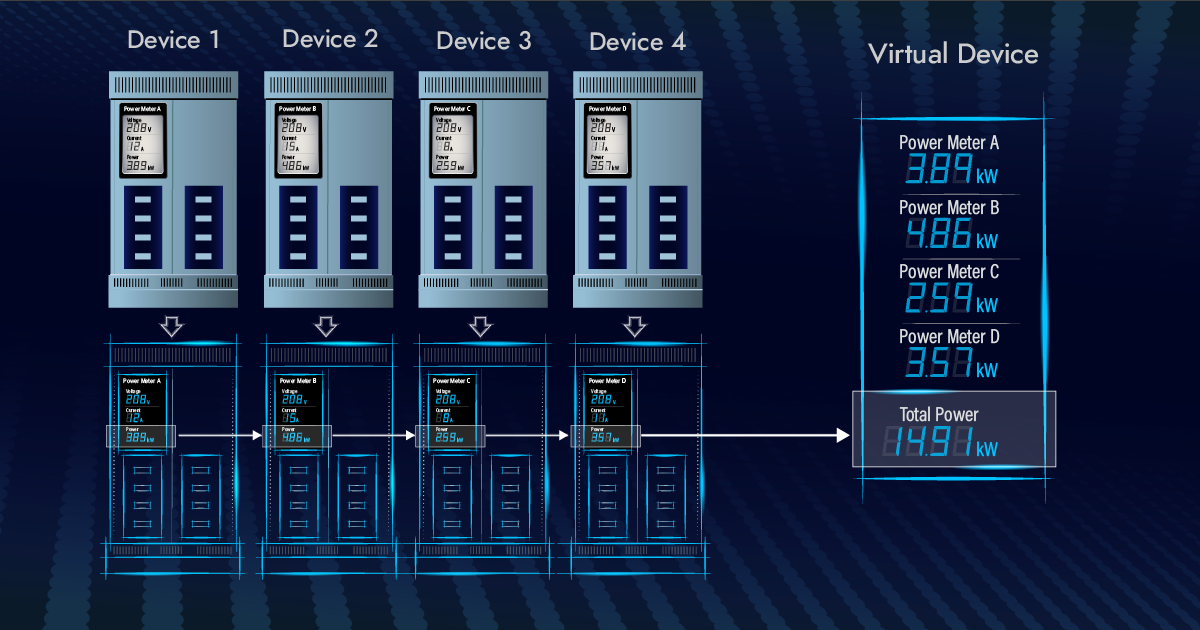
Virtualized devices allow operators to:
- Combine readings across electrical lineups, rooms, or sites
- Create calculated metrics such as totals, averages, and ratios
- Normalize data across mixed vendors and protocols
- Monitor logical systems rather than individual components
This shift from device-level monitoring to system-level insight is what unlocks exponential value.
Practical Use Cases for Virtualized Devices
Virtualized devices support a wide range of operational use cases, including:
- Total power aggregation: Real-time power totals at the rack, row, hall, or site level
- Efficiency metrics: Continuous calculation of PUE and related indicators
- Redundancy monitoring: Validation of circuit pair balance and failover readiness
- Generator runtime estimation: Aggregation of fuel, load, and runtime data
- Colocation visibility: Accurate tracking of customer energy usage and allocation
These use cases eliminate guesswork and manual reconciliation.
Turning Aggregation Into Action
Aggregation alone is not enough. The value of virtualized devices comes from treating calculated data as first-class operational signals.
When aggregated metrics are alarmed, trended, and reported just like physical data, operators gain:
- Faster detection of abnormal conditions
- Clear correlation between cause and effect
- Historical context for troubleshooting and planning
- Confidence in decisions based on complete information
Virtualized devices transform raw data into actionable intelligence.
Scaling Insight Across Distributed Environments
As data centers grow across multiple sites, consistency becomes critical. Virtualized devices enable standardized metrics regardless of physical layout or vendor differences.
This allows organizations to:
- Compare performance across locations
- Apply the same efficiency logic everywhere
- Maintain a single operational language across teams
Scalable aggregation ensures insight grows with the environment.
Consider Modius® OpenData®
Modius OpenData is a DCIM platform built around real-time, trusted data. It brings power, cooling, environmental, and asset information into one clear view, so operators can see what is happening across their facilities.
OpenData connects easily with other operations and IT tools, helping teams spot problems early, make safer changes, and run their data centers with more confidence.
OpenData provides management for virtualized devices, enabling data centers to aggregate and analyze infrastructure data beyond physical limits, delivering deeper visibility, more accurate metrics, and smarter operational decisions at scale.
Want to learn more? The DCIM Buyer’s Guide explains how to evaluate DCIM platforms, compare features, and plan a successful rollout.
Frequently Asked Questions (FAQs)
What is a virtualized device in DCIM?
Answer: A virtualized device is a software-defined object that aggregates data from multiple physical devices and performs calculations to create higher-level metrics.
How OpenData Solves the Problem: The platform allows operators to create and manage virtualized devices that behave like native infrastructure elements, complete with logging, alarms, and reporting.
Why are virtualized devices important for modern data centers?
Answer: Physical devices alone cannot represent system-level behavior such as total load, redundancy, or efficiency.
How OpenData Solves the Problem: OpenData aggregates data across devices to produce meaningful metrics that reflect how the infrastructure actually operates.
How do virtualized devices reduce operational risk?
Answer: They expose conditions that are invisible at the device level, such as imbalanced loads or aggregate thresholds being exceeded.
How OpenData Solves the Problem: Calculated metrics are continuously monitored, allowing early detection of issues before they escalate.
Can virtualized devices support multi-vendor environments?
Answer: Yes. Aggregation is essential when infrastructure includes equipment from different manufacturers.
How OpenData Solves the Problem: OpenData normalizes data across protocols and vendors, enabling consistent virtualized metrics.
How do virtualized devices improve reporting and analytics?
Answer: They provide higher-level metrics that are easier to analyze, trend, and act upon.
How OpenData Solves the Problem: Aggregated values flow directly into analytics and dashboards without manual manipulation.
About Modius
Modius delivers real-time, scalable infrastructure management software purpose-built for critical facilities—from data centers to telecom, smart buildings, and beyond.
Our flagship platform, OpenData, unifies operational and IT systems into a single pane of glass, empowering teams with actionable insights across power, cooling, environmental, and IT assets.
By eliminating fragmented tools and enabling predictive analytics, capacity planning, and 3D visualization, Modius helps operators master both white and gray space with confidence.
Contact: sales@modius.com | (888) 323-0066 | www.modius.com