
Measuring PUE with Shared Resources
TL;DR: Measuring PUE in data centers that share mechanical resources (such as a campus chilled-water system) requires allocating the shared cooling system’s power consumption proportionally. The ideal approach uses sub-metered chilled-water flow and temperature data with the formula Pdc = Pmech × (qΔTdc / qΔTmech). When perfect instrumentation is unavailable, options include using existing CRAH data, retrofitting ultrasonic flow meters, or applying surface temperature sensors to pipes.
Last week I wrote a little about measuring the total power in a data center, when all facility infrastructure are dedicated to supporting the data center. Another common situation is a data center in a mixed environment, such as a corporate campus or an office tower, at which the facility resources are shared. The most common shared resource is the chilled-water system, often referred to as the “mechanical yard.” As difficult as it sometimes can be to set up continuous power monitoring for a stand-alone data center, it is considerably trickier when the mechanical yard is shared. Again, simple in principle, but often surprisingly painful in practice.
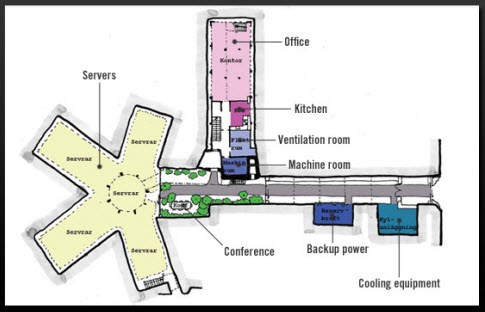
One way to address this problem is to use The Green Grid’s partial PUE, or pPUE. While the number should not be used as a comparison against other data centers, it provides a metric to use for tracking improvements within the data center.
This isn’t always a satisfactory approach, however. Given that there is a mechanical yard, it’s pretty much guaranteed to be a major component of the overall non-IT power overhead. Using a partial PUE (pPUE) of the remaining system and not measuring, or at least estimating, the mechanical yard’s contribution masks both the overall impact of the data center and the impact of any efficiency improvements you make.
There are a number of ways to incorporate the mechanical yard in the PUE calculations. Full instrumentation is always nice to have, but most of us have to fall back on approximations. Fundamentally, you want to know how much energy the mechanical yard consumes and what portion of the cooling load is allocated to the data center.
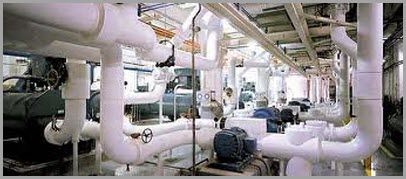
The Perfect World
In an ideal situation, you have the mechanical yard’s power continuously sub-metered—chillers, cooling towers, and all associated pumps and fans. Not unusual to have a single distribution point where measurement can be made. Perhaps even a dedicated ATS. Then for the ideal solution, all you need is sub-metering of the chilled-water going into the data center.
The heat load, h, of any fluid cooling system can be calculated from the temperature change, ∆T, and the overall flow rate, q: h=Cq∆T, where C is a constant that depends on the type of fluid and the units used. As much as I dislike non-metric units, it is easy to remember that C=500 when temperature is in °F and flow rate is in gal/min, giving heat load in BTU/h. (Please don’t tell my physics instructors I used BTUs in public.) Regardless of units, the total power to allocate to your data center overhead is Pdc=Pmech(hdc⁄hmech). Since what matters is the ratio, the constant C cancels out and you have Pdc=Pmech (q∆Tdc⁄q∆Tmech).
You’re pretty much guaranteed to have the overall temperature and flow data for the main chilled-water loop in the BMS system already, so you have q∆Tmech. Much less likely to have the same data for just the pipes going in and out of your data center. If you do, hurrah, you’re in The Perfect World, and you’re probably already monitoring your full PUE and didn’t need to read this article at all.
Perfect and You Don’t Even Know It
Don’t forget to check the information from your floor-level cooling equipment as well. Some of them do measure and report their own chilled-water statistics, in which case no additional instrumentation is needed. In the interest of brand neutrality, I won’t go into specific names and models in this article, but feel free to contact me with questions about the information available from different equipment.
Perfect Retrofit
If you’re not already sub-metered, but you have access to a straight stretch of pipe at least a couple feet long, then consider installing an ultrasonic flow meter. You’ll need to strap a transmitter and a receiver to the pipe, under the insulation, typically at least a foot apart along the pipe. No need to stop the flow or interrupt operation in any way. Either inflow or outflow is fine. If they’re not the same, get a mop; you have other more pressifng problems. Focus on leak detection, not energy monitoring.
If the pipe is metal, then place surface temperature sensors directly on the outside of the inflow and outflow pipes, and insulate them well from the outside air. Might not be the exact same temperature as the water, but you can get very close, and you’re really most concerned about the temperature difference anyway. For non-metal pipes, you will have to insert probes into the water flow. You might have available access ports, if you’re lucky.
The Rest of Us
Next week I’ll discuss some of the options available for the large population of data centers that don’t have perfect instrumentation, and can’t afford the time and/or money to purchase and install it right now.
Frequently Asked Questions
What is partial PUE (pPUE) and when is it used?
Partial PUE (pPUE), defined by The Green Grid, measures efficiency using only the directly metered components of a data center’s power chain, excluding shared resources. It is used when the mechanical yard is shared and full PUE measurement is not feasible. However, pPUE should not be compared across different facilities.
How do you calculate the data center’s share of shared cooling power?
The data center’s share is calculated using the heat load ratio: Pdc = Pmech × (hdc / hmech). Since heat load h = C × q × ΔT (where q is flow rate and ΔT is temperature change), and the constant C cancels out, the formula simplifies to Pdc = Pmech × (qΔTdc / qΔTmech).
What is an ultrasonic flow meter and why use one for PUE?
An ultrasonic flow meter measures chilled-water flow rate by clamping transmitter and receiver sensors onto the outside of a pipe, requiring no interruption to operations. It is an ideal retrofit option for data centers that need to sub-meter chilled water for PUE calculation but lack existing instrumentation.
Can surface temperature sensors replace inline probes for PUE measurement?
For metal pipes, surface temperature sensors placed under insulation on inflow and outflow pipes can approximate water temperature closely enough for PUE calculations, since the key measurement is the temperature difference rather than absolute values. Non-metal pipes require inline probes inserted into the water flow.
Why does PUE matter for shared-resource data centers?
Accurate PUE measurement helps shared-resource data centers identify the true energy overhead of cooling, track efficiency improvements over time, and justify investments in infrastructure upgrades. Without measuring the shared mechanical yard’s contribution, efficiency gains in cooling remain invisible.