

Your annual energy report may show that you met a renewable electricity target. Can your team prove the same result for a specific hour last Tuesday?
Answering that question can mean pulling meter histories, requesting records from energy suppliers, and lining up timestamps across systems, all while your team still has a facility to run.
Spain may soon require new data centers to prove that renewable power matches their electricity use every hour. An annual total would no longer count on its own. For operators focused on data center PUE, that raises a new question: can you show when you used power and where it came from?
TL;DR
- Spain has proposed regulations for new data centers of 1 MW or more. At least 80% of electricity use would need to match new renewable generation in the same hour.
- PUE still matters for data center energy efficiency. But it can’t show when a facility used power or whether renewable supply was there at the time.
- Hourly reporting depends on aligned meter, utility, generation, and sustainability data.
- A useful first test is one facility and one week of interval data. That can expose missing records and timestamp problems before reporting becomes urgent.
What Spain is proposing
On August 26, Data Center Dynamics reported on a draft Spanish regulation. It would cover new data centers of 1 MW or more. It would require at least 80% of electricity use to match new renewable generation on an hourly basis.
The proposal also includes energy- and water-efficiency requirements. More than 10 GW of data center projects are reportedly seeking Spanish grid connections. Read the DCD report.
The Spanish government’s announcement confirms the hourly rule. It also ties compliance to grid access and sets penalties for noncompliance. Read the government announcement.
These requirements are still a proposal and could change. But the lesson already applies. When customers or regulators ask for detailed energy evidence, annual totals may no longer be enough.
Why this matters to other data centers
The Greenhouse Gas Protocol is revising its Scope 2 guidance. One proposal would move corporate energy reporting toward hourly matching instead of annual matching. The GHG Protocol expects to finalize the standard in 2027. Read the GHG Protocol announcement.
For US operators, the near-term question is readiness rather than compliance. If a customer, regulator, or sustainability team asks for hourly evidence, how quickly can you produce it?
Annual totals can hide the hours that matter
Here’s a simple example. A facility uses 10 MWh of power between 2 p.m. and 3 p.m. With an 80% hourly rule, at least 8 MWh of that power must come from renewable sources during that same hour.
If only 6 MWh qualifies, the facility has a 2 MWh shortfall. Renewable generation later in the day would not close that earlier gap.
That changes the work. Procurement needs to know when contracted generation is available, while facilities needs a reliable consumption record. Sustainability then connects both records and explains any gaps.
The reporting burden starts where systems stop talking
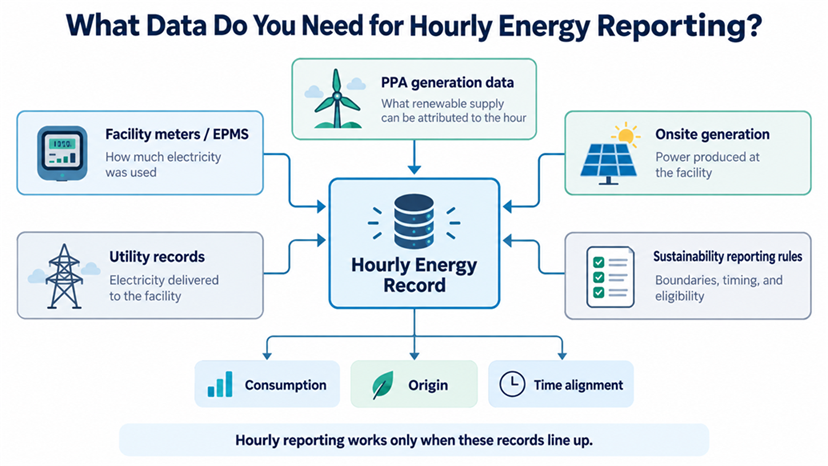
The consumption record may sit in an EPMS. Utility data may arrive through a separate portal. A supplier may hold PPA generation records. Teams may track onsite generation and sustainability reporting elsewhere.
A useful hourly record connects four types of evidence:
- Facility consumption: how much electricity the data center used.
- Utility and onsite generation: electricity delivered to or produced at the facility.
- PPA generation records: which renewable supply you can match to each hour.
- Sustainability rules: the reporting boundary, timing, and eligibility requirements.
How can data center operators measure hourly energy use?
Start with interval meter data at the same boundary used for reporting, and use a consistent interval and time zone. Keep enough history to answer questions months later.
Next, gather the records that show where your power came from. These can include PPA generation data, supplier certificates, and onsite generation records. Each reporting standard has its own rules for which energy counts.
Keep consumption and origin separate. A meter can prove how much electricity a facility used. It cannot prove where that electricity came from or whether it qualifies as renewable energy.
How facility load lines up with renewable availability
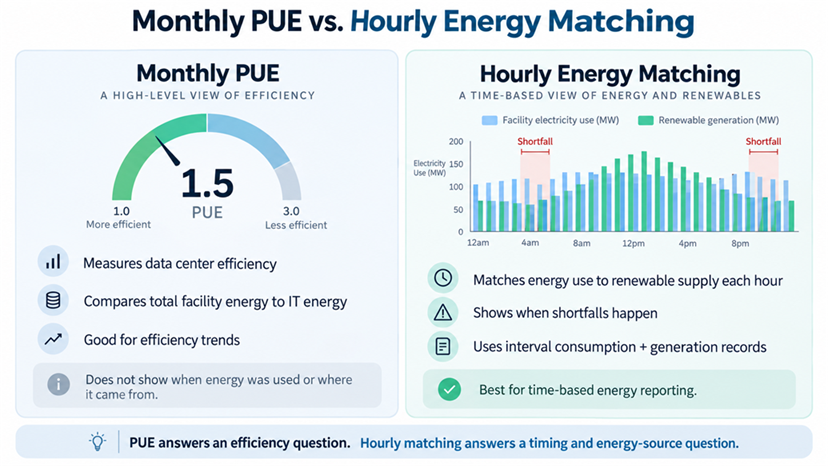
Once consumption and generation share the same timeline, teams can compare load patterns instead of annual totals. Data center energy consumption is often steady, while solar and wind output vary by time and weather.
That makes shortfalls easier to see. Procurement can evaluate a different generation mix, storage, or contracted supply. Facilities can see whether changes in load shift the gap.
What monthly PUE reports miss
Power usage effectiveness (PUE) compares total facility power with the power used by IT equipment. It remains a useful measure of data center energy efficiency.
But data center PUE answers an efficiency question. Hourly matching answers a timing and energy-source question. A monthly average PUE measurement does not show when the facility used electricity, where that electricity came from, or whether renewable generation was available at the same time.
Cooling strategies, facility power improvements, and other infrastructure changes can improve PUE and deliver efficiency gains. They may also reduce energy costs and total power consumption. They still do not prove the source of electricity in a specific hour.
Real-time and interval monitoring helps operators see both sides: how efficiently the data center operates and when its energy use occurs.
Make the hourly record useful before reporting is due
Start with one facility and one representative week. Line up hourly consumption with the related generation records. Then record what is missing, who owns each source, and how long matching takes.
This can expose problems early. A supplier may provide only monthly summaries, a meter may cover the wrong reporting boundary, or a timestamp may use a different time zone. Those issues are much easier to fix before a deadline.
How OpenData supports the consumption side
Modius OpenData® supports hourly aggregation of power data. That gives operators a starting point for understanding when facility demand occurs and for building the consumption history needed for comparison with renewable supply.
OpenData brings operational data from different infrastructure systems into a unified view. Reporting and open API capabilities help teams share that data with other platforms. Explore Modius OpenData.
Hourly renewable matching would still require the appropriate utility, PPA, generation, and eligibility records. Hourly aggregation supports the process; it does not establish compliance on its own.
If your next energy reporting request asks for hourly evidence, how much of the answer can your team produce today?
Frequently Asked Questions
What is hourly renewable matching?
It is a way to show that qualifying renewable generation occurred in the same hour a facility used electricity, instead of matching annual totals.
Modius OpenData records facility energy use hour by hour, which gives you the consumption side of that match.
Does Spain’s proposed regulation apply to US data centers?
No, the proposal would apply to new facilities in Spain of 1 MW or more. US operators should still watch the broader move toward more granular corporate energy reporting.
Modius OpenData keeps detailed interval history, so you can answer hourly questions later without rebuilding your records.
Can existing PUE reports prove hourly matching?
No, PUE measures data center energy efficiency. It does not show when a facility consumed electricity or whether the supply was renewable.
Modius OpenData reports PUE and hourly consumption from the same system, so you don’t need two separate processes.
Why is hourly reporting harder than annual reporting?
The data often sits in different systems. At hourly resolution, missing intervals, clock drift, and boundary mismatches become much easier to see.
How OpenData Solves the Problem: Modius OpenData brings data from mixed equipment into one record, which makes gaps and timing issues easier to find and fix.
What should operators do first?
Pick one facility and one week. Pull interval consumption data, request the related generation records, and try to align them by hour.
Modius OpenData already provides the consumption data for that test, so you can run it with real data right away.
Ready to see how OpenData can support a clearer record of facility energy use? Schedule a personalized demo and we’ll help you find the data connections to future-proof your reporting.