
Executive Summary
Hot aisle containment captures hot server exhaust in an enclosed aisle and routes it directly to cooling units, while cold aisle containment isolates the cold air supply to server intake faces. Both strategies reduce air mixing and improve cooling efficiency. DCIM software enhances both approaches by providing real-time temperature monitoring, hot-spot identification, capacity planning, and energy optimization analytics.
What Is Aisle Containment in a Data Center?
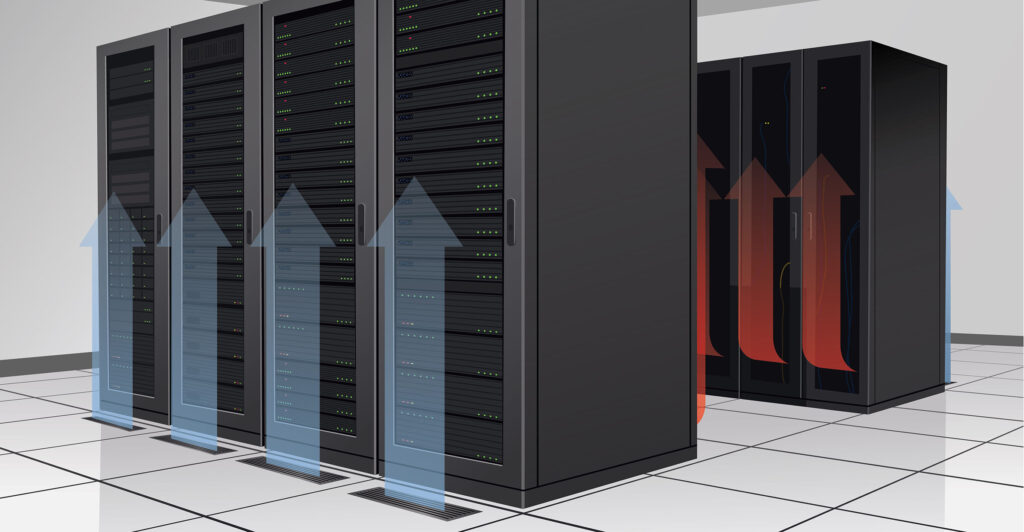
Aisle containment is a data center cooling strategy that physically separates hot exhaust air from cold supply air within server rows. Without containment, hot and cold air mix freely across the raised floor, forcing cooling systems to work harder and consuming excess energy. By sealing either the hot aisle or the cold aisle—or both—operators can dramatically reduce cooling overhead, lower PUE, and extend equipment lifespan.
The two primary strategies are hot aisle containment (HAC) and cold aisle containment (CAC). Each has distinct design implications, cost profiles, and operational trade-offs.
Hot Aisle Containment vs. Cold Aisle Containment: Key Differences
| Factor | Hot Aisle Containment | Cold Aisle Containment |
|---|---|---|
| What is sealed | Hot exhaust aisle | Cold supply aisle |
| Air flow direction | Hot air ducted directly to CRAC/CRAH units | Cold air contained at server intake faces |
| Ambient floor temperature | Cooler (hot air removed efficiently) | Warmer (hot air disperses to open floor) |
| Worker comfort | More comfortable ambient environment | Workers may experience heat in open aisles |
| Implementation complexity | Higher (requires ceiling or duct integration) | Lower (containment panels at aisle ends) |
| Fire suppression consideration | Requires system design for contained hot aisle | Simpler to retrofit |
How Does Hot Aisle Containment Work?
In hot aisle containment, server racks face each other so their exhaust fans all blow into a single enclosed aisle. That aisle is sealed with doors, curtains, or a physical ceiling, and the hot air is ducted directly into the return path of computer room air conditioning (CRAC) or computer room air handling (CRAH) units. Because hot air never mixes with the cold supply air, the cooling system operates at maximum efficiency.
Key advantages of hot aisle containment include lower return air temperatures to cooling units, higher allowable server inlet temperatures (per ASHRAE guidelines), and a more comfortable working environment on the open floor.
How Does Cold Aisle Containment Work?
Cold aisle containment isolates the cold supply air by enclosing the aisle where server intake faces are located. Raised-floor perforated tiles or overhead supply ducts deliver cold air exclusively to this enclosed aisle, and end caps prevent cold air from escaping into the general room environment. Hot air expelled from server exhausts disperses into the open room and is returned to cooling units via ceiling return paths or overhead plenum.
Cold aisle containment is generally simpler and less expensive to retrofit into existing data centers, making it a common first step for facilities looking to improve energy efficiency.
How Does DCIM Optimize Aisle Containment Strategies?
Data Center Infrastructure Management (DCIM) software plays a critical role in maximizing the effectiveness of both hot and cold aisle containment. By integrating sensors, power meters, and cooling systems, DCIM delivers real-time environmental visibility that containment strategies alone cannot provide.
Real-Time Temperature and Humidity Monitoring
DCIM collects live temperature and humidity data from sensors placed throughout the data center. Operators can immediately identify hot spots—areas where containment may be compromised or cooling is insufficient—and take corrective action before equipment is stressed.
Capacity Planning and Predictive Analytics
Historical data collected by DCIM enables predictive capacity planning. Operators can model the thermal impact of adding new equipment, rebalancing loads across aisles, or modifying containment configurations—without risking live infrastructure.
Energy Efficiency and Cooling Optimization
DCIM exposes cooling inefficiencies by correlating power load data with thermal readings. This allows precise control over setpoints, fan speeds, and cooling unit configurations, reducing energy waste and improving PUE. Modius OpenData normalizes data from diverse cooling equipment vendors into a single actionable view, eliminating the blind spots that siloed BMS and EPMS systems create.
What to Look for in a DCIM Solution for Cooling Optimization
The DCIM Buyer’s Guide outlines the key capabilities operators should evaluate, including sensor integration breadth, analytics depth, and the ability to support both hot and cold aisle containment monitoring within the same platform.
Frequently Asked Questions
What is the main difference between hot aisle and cold aisle containment?
Answer: Hot aisle containment seals the aisle where servers exhaust heat and ducts that hot air directly to cooling units. Cold aisle containment seals the aisle where servers draw in cool air, keeping the supply air concentrated at server intakes. Both reduce hot/cold air mixing, but hot aisle containment generally delivers higher cooling efficiency and a more comfortable ambient environment.
Which containment strategy is better for energy efficiency?
Answer: Hot aisle containment typically delivers superior energy efficiency because it removes heat at the source and delivers it directly to cooling equipment, minimizing recirculation losses. However, the best choice depends on the existing facility layout, ceiling height, cooling system type, and retrofit costs. A DCIM platform can model both scenarios with real data to guide the decision.
How does DCIM help identify hot spots in a contained aisle environment?
Answer: DCIM software aggregates readings from temperature sensors deployed throughout the data center—including inside containment zones—and surfaces anomalies in real time. Modius OpenData provides real-time, normalized environmental data through a single pane of glass, enabling operators to pinpoint hot spots and correlate them with specific equipment or containment breaches.
Can DCIM work with both hot aisle and cold aisle containment simultaneously?
Answer: Yes. Enterprise DCIM solutions are agnostic to containment strategy and can monitor both configurations within the same facility. This is particularly useful in mixed-density environments where different rows may use different containment approaches.
What role does DCIM play in capacity planning for contained data centers?
Answer: DCIM provides historical environmental and power data that feeds predictive capacity models. Operators can simulate the thermal impact of new deployments, assess whether existing containment configurations can support increased density, and make data-driven decisions about infrastructure changes. Most DCIM platforms offer basic capacity reporting; Modius OpenData adds normalized, real-time data streams that make these models more accurate.
Is cold aisle containment suitable for retrofitting older data centers?
Answer: Cold aisle containment is generally easier and less expensive to retrofit than hot aisle containment because it requires only end caps and overhead panels rather than ceiling duct integration. Many older facilities start with cold aisle containment as a cost-effective first step and use DCIM data to evaluate the incremental benefit of transitioning to full hot aisle containment.